About Me

I am a scientist working in the field of high-energy astrophysics, specifically gamma-ray and X-ray astronomy. Currently, I work in the Institute of Nuclear Physics in Poland. I am a member of the H.E.S.S. (High Energy Stereoscopic System) Collaboration and the Cherenkov Telescope Array Observatory (CTAO) Consortium.

My scientific interests relate to the understanding of the most extreme environments in the Universe especially active galactic nuclei and blazars. In my research I use data collected with several instruments, spanning broad energy bands from radio frequencies up to the very-high-energy gamma rays to understand the physical picture of these sources.

The full list of my publications can be found here. Feel free to contact me about potential Postdoc, PhD, Master or Bachelor Projects in our group.

Education
  • Habilitation in Physics, 2022

    Institute of Nuclear Physics, Polish Academy of Sciences, Kraków, Poland

  • PhD in Astronomy, 2013

    Jagiellonian University, Faculty of Physics, Astronomy and Applied Computer Science, Kraków, Poland

  • Master in Physics, 2009

    Jagiellonian University, Faculty of Physics, Astronomy and Applied Computer Science, Kraków, Poland

Experience



Institute of Nuclear Physics, Polish Academy of Sciences
Associate Professor
Institute of Nuclear Physics, Polish Academy of Sciences
May 2023 – Present Kraków, Poland


Astronomical Observatory of Heidelberg University
Bekker Fellowship
Astronomical Observatory of Heidelberg University
May 2024 – Oct 2024 Heidelberg, Germany


Institute of Nuclear Physics, Polish Academy of Sciences
Adjunct Professor
Institute of Nuclear Physics, Polish Academy of Sciences
Nov 2013 – May 2023 Kraków, Poland


Astronomical Observatory of Heidelberg University
Bekker Fellowship
Astronomical Observatory of Heidelberg University
Mar 2019 – Feb 2020 Heidelberg, Germany


Astronomical Observatory of Heidelberg University
Mobility Plus Fellowship
Astronomical Observatory of Heidelberg University
Sep 2014 – Aug 2015 Heidelberg, Germany

Recent Publications

20 years of monitoring: PKS 2155 - 304 and PKS 1510 - 089 in the eyes of Swift and Fermi. I. The case of PKS 2155 - 304

Alicja Wierzcholska, Michael Zacharias
Published online on 5 July 2026 in Journal of High Energy Astrophysics
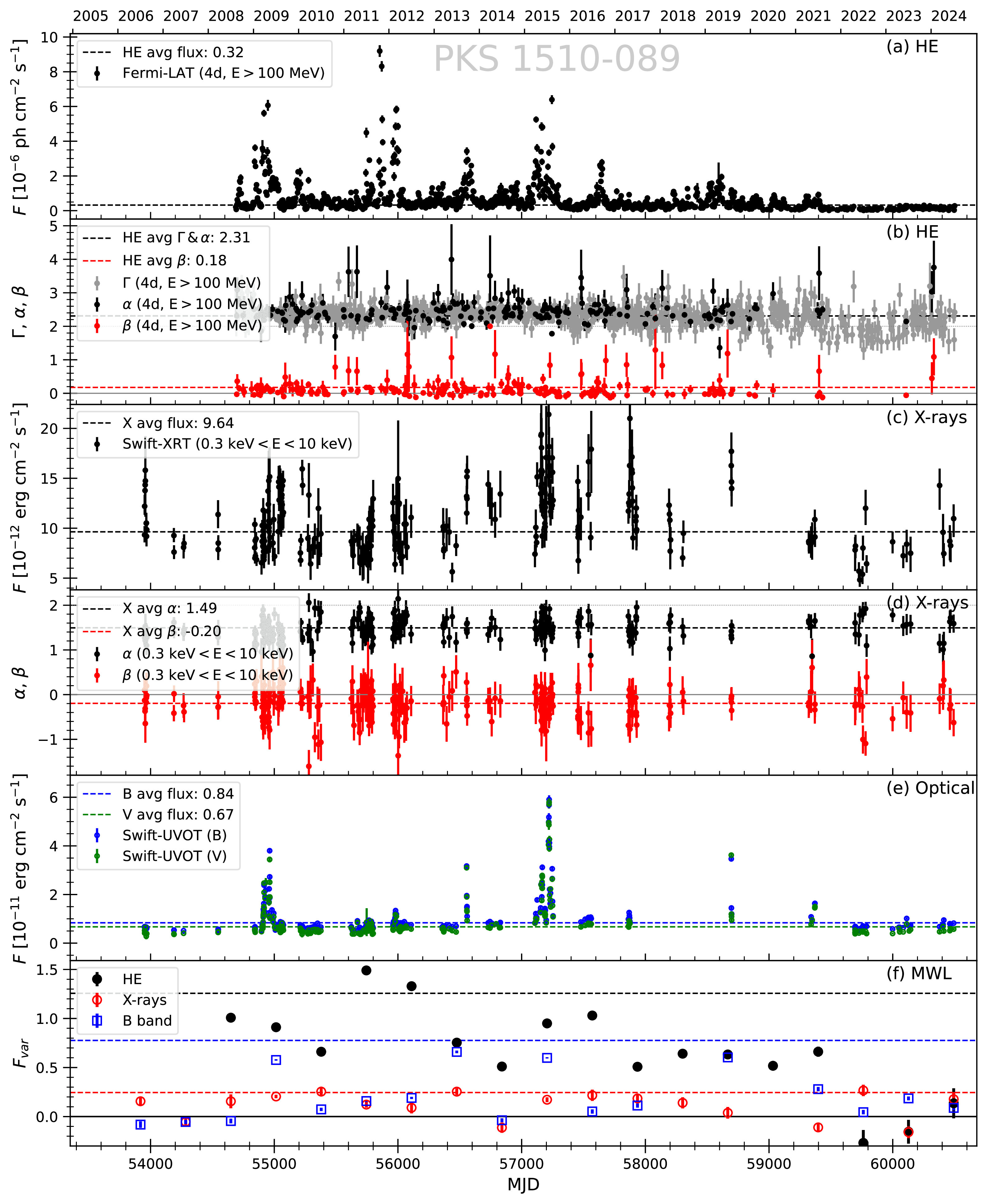
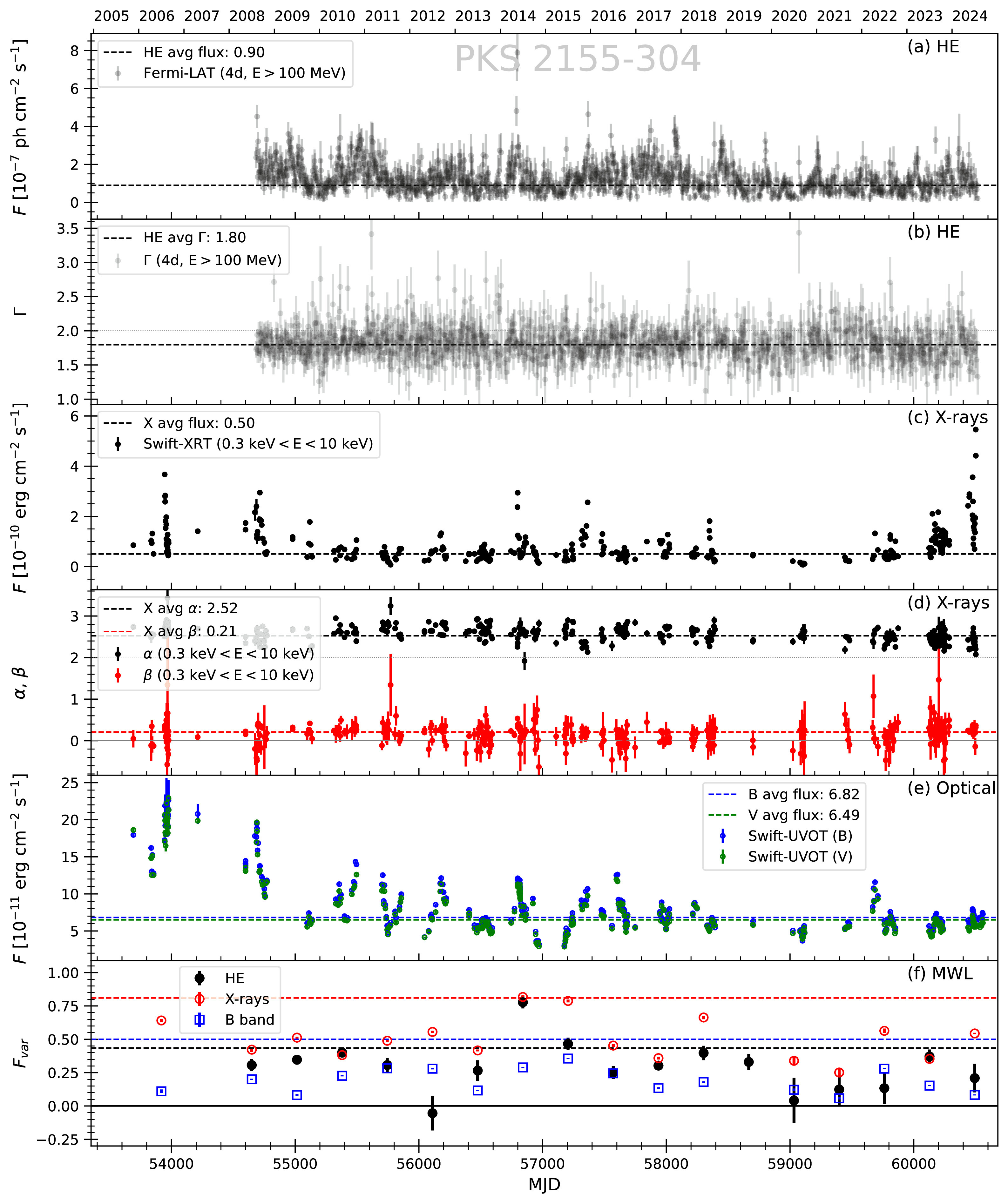
Time-evolution of PKS 2155 - 304 from 2005 to 2024. (Fig. 1 in the paper)
We present a comprehensive 20-year multiwavelength variability study of the blazar PKS 2155 - 304, one of the most luminous and extensively monitored high-frequency-peaked BL Lac objects in the southern hemisphere. Using Fermi-LAT γ-ray data together with Swift-XRT and UVOT observations spanning 2005–2024, we trace the long-term evolution of its flux, interband correlations, and spectral behaviour across the optical, X-ray, and γ-ray bands. While the HE γ-ray and X-ray flux distributions are compatible with log-normality, the optical band prefers a double-log-normal fit. The latter matches well the baseline flux change that took place in the optical range around 2009, and which is clearly visible in the flux distribution. While interband flux–flux correlations are found, no stable temporal lags emerge. This implies varying correlation patterns between epochs. The X-ray emission displays a robust harder-when-brighter trend, however with epoch-dependent slopes, while the γ-ray spectra show only mild flux dependence. The fractional variability increases systematically with energy within a given radiation component. No direct correlation of the year-wise fractional variability with the corresponding average flux could be found. Interestingly, a pronounced X-ray spectral upturn, detected during a low state in 2012, points to an additional radiative component. As the connection from this upturn to the γ-ray spectrum is not smooth, it probably is not the onset of the inverse-Compton component, but more likely points either to a hadronic contribution or an additional spatially-separate emission zone. These findings reveal the complexity of variability patterns in PKS 2155 - 304 and the non-uniform nature of its particle acceleration and emission processes.

Disentangling two spectral components in the X-ray emission of the blazar 1ES 0229+200

Alicja Wierzcholska, Hubert Siejkowski
Published online on 14 November 2025 in Astronomy & Astrophysics
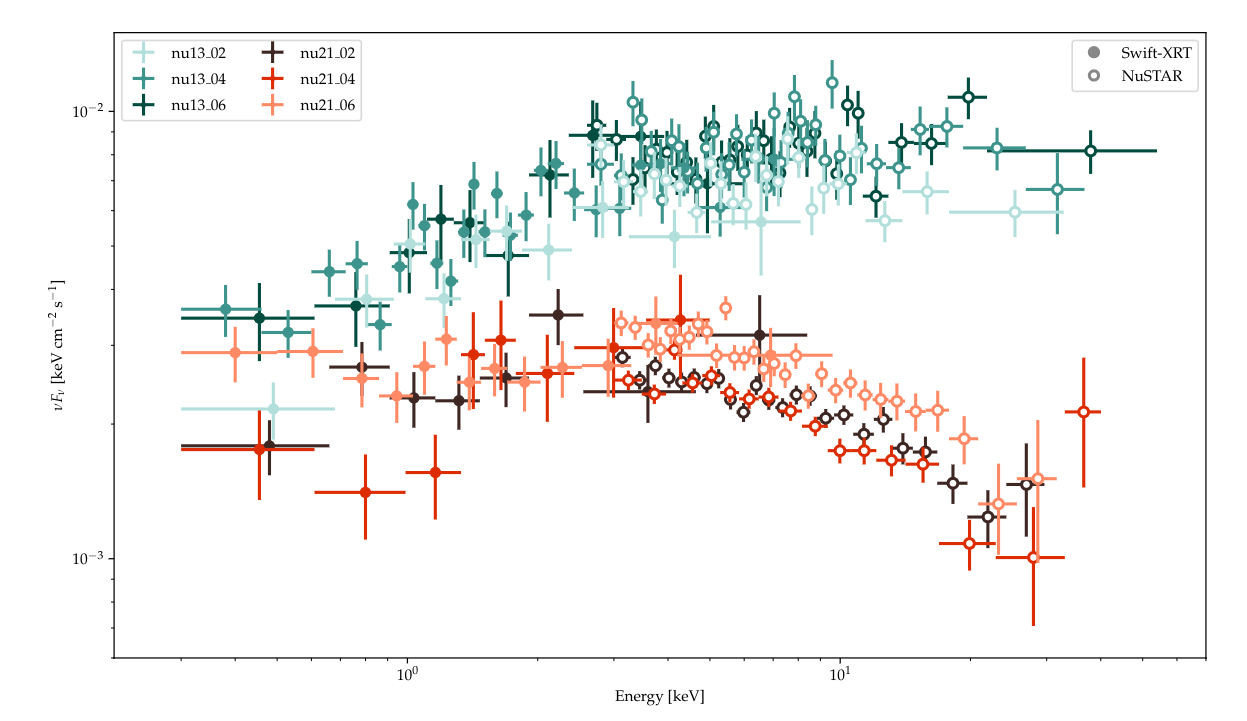
Spectral energy distributions presenting NuSTAR and Swift-XRT observations for six epochs. (Fig. 3 in the paper)
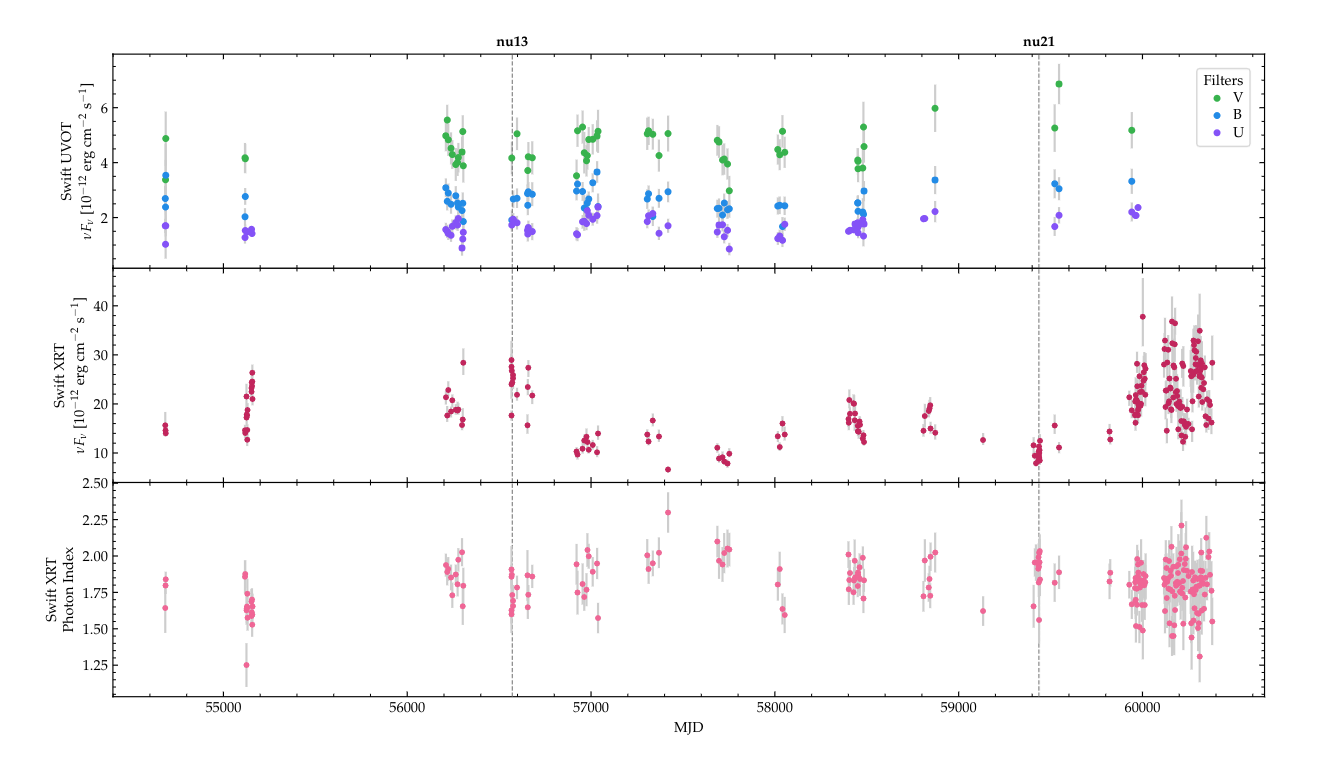
Multi-wavelength light curve of 1ES 0229+200 presenting long-term (2008-2024) observations of the blazar. (Fig. 1 in the paper)
X-ray observations are essential to achieve a deeper understanding of the broadband emission mechanism in blazars. Here, we present a long-term spectral and temporal analysis of X-ray and optical observations of 1ES 0229+200 collected with the Neil Gehrels Swift Observatory from 2008 to 2024, complemented by hard X-ray observations from the Nuclear Spectroscopic Telescope Array (NuSTAR). The blazar 1ES 0229+200 is a high-frequency, peaked BL Lac object, known for its exceptionally hard very high-energy (VHE) γ-ray spectrum extending up to 10 TeV. In August 2021, NuSTAR observed the source in a low X-ray state, revealing a concave spectral shape with a distinct upturn around 25 keV. This feature contrasts with previous observations performed with NuSTAR and Swift-BAT, which showed no such spectral upturn. Previous observations of 1ES 0229+200 and broadband SED (spectral energy distribution) modelling suggest that its X-ray emission extends beyond 100 keV without a significant cutoff. The newly detected spectral upturn may indicate a transition between the synchrotron and inverse Compton components or could be linked to photohadronic processes involving high-energy neutrinos. We discuss the implications of this finding in the context of blazar spectral energy distributions, particularly the potential existence of a third SED bump in the kiloelectronvolt to megaelectronvolt range. The observed spectral features support the hypothesis that 1ES 0229+200 could be a source of high-energy neutrino emission.

Exceptional X-ray activity in BL Lacertae

Alicja Wierzcholska, Stefan Wagner
Published online on 28 January 2025 in Astronomy & Astrophysics
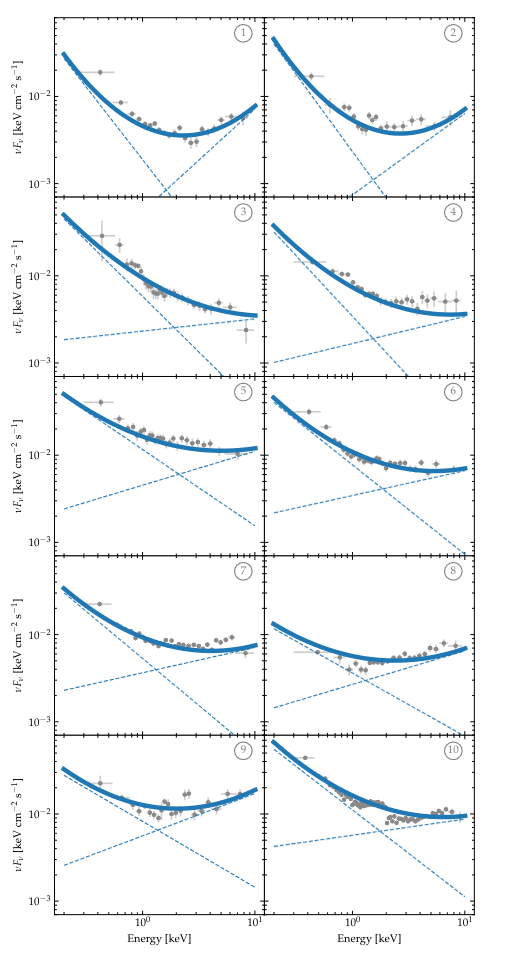
Spectral variations during the observation period. Each spectrum is derived for different intervals. (Fig. 9 in the paper)
BL Lacertae is a unique blazar for which the X-ray band can cover either the synchrotron or the inverse Compton, or both parts of the broadband spectral energy distribution. In the latter case, when the spectral upturn is located in the X-ray range, it allows contemporaneous study of the low- and high-energy ends of the electron distribution function. In this work, we study spectral and temporal variability using X-ray and optical observations of the blazar performed with the Neil Gehrels Swift Observatory from 2020 to 2023. The large set of observational data reveals intensive flaring activity, accompanied by spectral changes in both spectral branches. We conclude that the low-energy and high-energy ends of the particle distribution function are characterised by similar variability scales. Additionally, the hard X-ray observations of BL Lacertae performed with the Nuclear Spectroscopic Telescope Array (NuSTAR) confirm a concave spectral curvature for some epochs of the blazar activity and reveal that it can be shifted up to energies of as high as 8 keV. The time-resolved spectral analysis allows us to disentangle X-ray spectral variability features of the synchrotron from inverse Compton components. Despite significant variability of both spectral components, we find only small changes in the position of the spectral upturn. The different slopes and shapes of the X-ray spectrum of BL Lacertae demonstrate that the classification of this source is not constant, and BL Lacertae can exhibit features of either high-, intermediate-, or low-energy peaked blazar in different epochs of observation. This also indicates that the spectral upturn for this blazar can be located not only in the X-ray range of 0.3−10 keV, but also at lower or higher energies.
The list of my publications is availble on ADS.